Service registry configuration
Note that the gateway is experimental and might not be fully functional for production yet.
boruta can work as a cluster, providing instances of an identity platform to secure infrastructures. Each running node publishes a service registry record describing how it can be reached and which gateway services it exposes.
Service registry
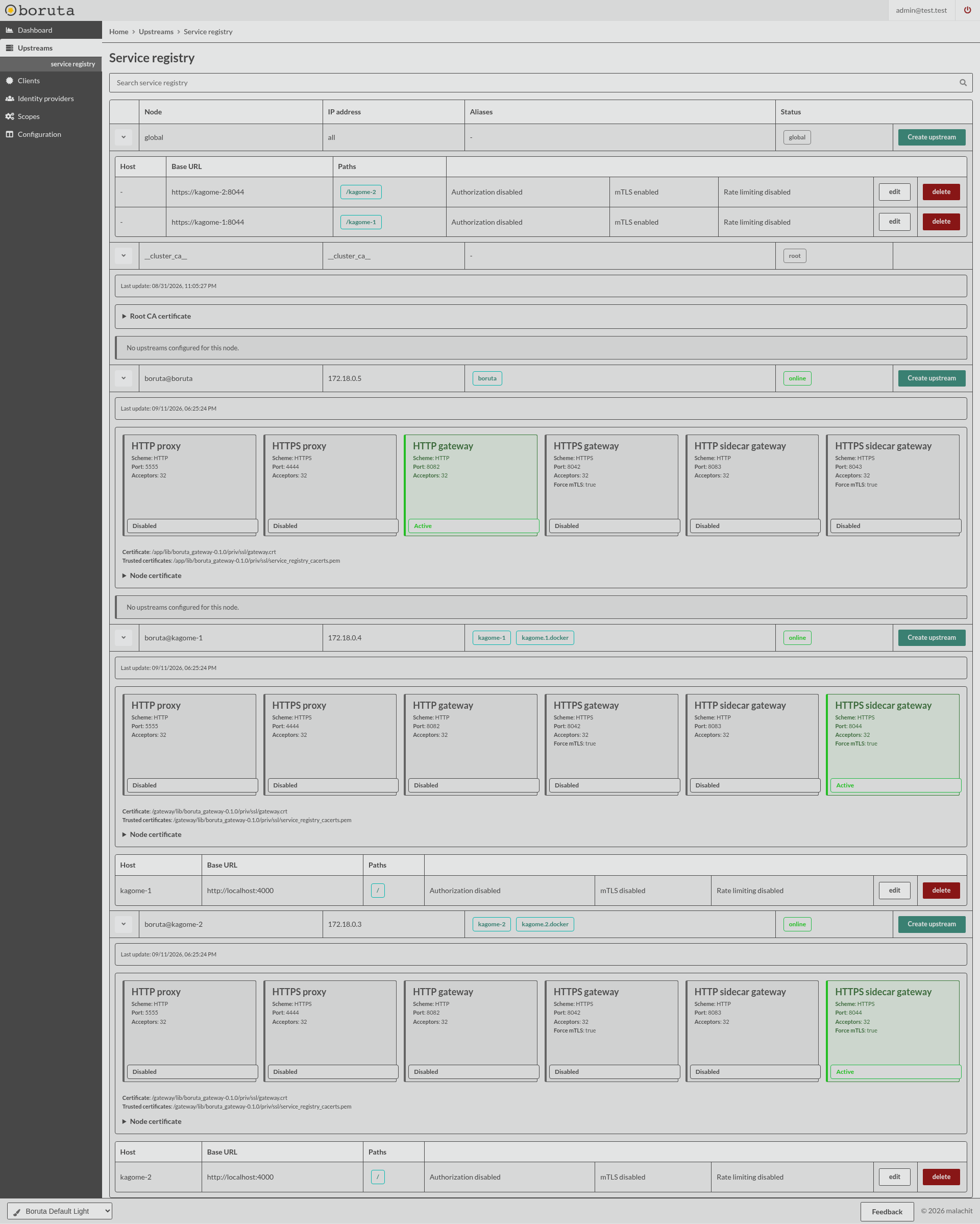
At startup, a node ensures the cluster root CA exists, creates or updates its own registry record, and marks it as online. The record contains the node_name, Erlang node name, IP address, aliases, node certificate, exposed service configuration, and status. A registry record is unique by node_name; when a node starts again with the same node_name, it updates the existing record.
The IP address is selected from the first non-loopback network interface, falling back to 127.0.0.1 when no non-loopback address is available. Aliases come from static configuration and are completed with the node hostname. Records are visible in the administration interface within the Upstreams > service registry section.
The registry is refreshed through database notifications and periodic checks. Every node touches its own record every 5 seconds and tries to reach other registered Erlang nodes. A node that cannot be reached for about 30 seconds is removed from the registry. When a node stops normally, its record is marked offline.
The global entry displayed in the administration interface is a gateway configuration helper, not a stored service registry record. It is used to manage upstreams that are served by the main gateway entrypoint.
Upstreams
Upstreams define how gateway requests are forwarded to backend services. They are grouped by node_name.
global upstreams are used by the main gateway. Upstreams attached to a service registry node are used by that node's sidecar gateway. This lets the same administration view configure both central gateway routes and microgateway routes close to registered services.
Microgateway / Sidecars
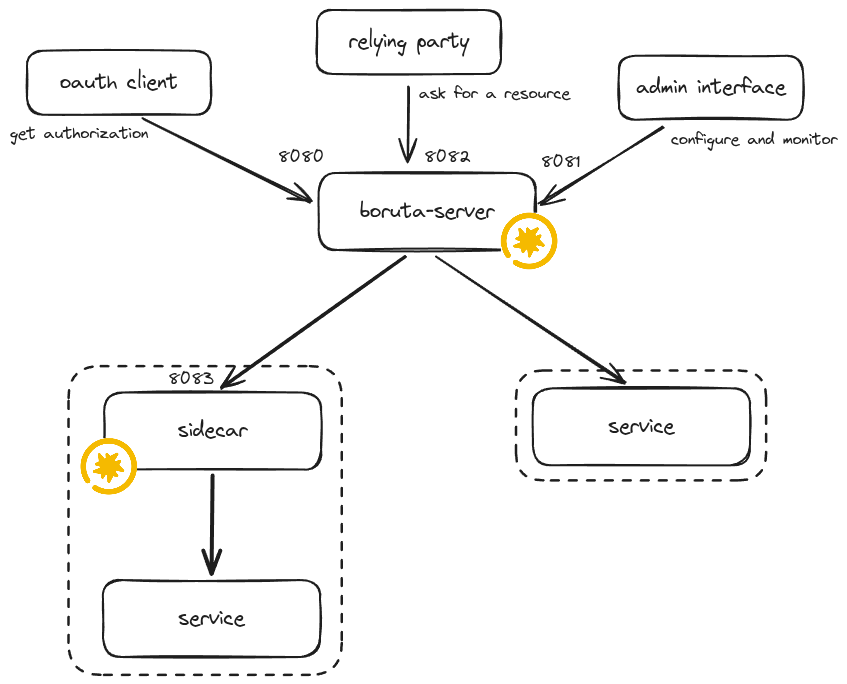
More than a single gateway, boruta can act as a microgateway. A node publishes both central gateway services and sidecar gateway services in its service registry configuration. The administration interface shows each configured service with its scheme, port, acceptor count, enabled state, and client-certificate verification setting when applicable.
The active upstream node is selected with the node_name attribute. gateway static configuration creates global upstreams. microgateway static configuration creates upstreams for a specific node, defaulting to the current node name when node_name is omitted.
The main HTTP and HTTPS gateway ports are configured with BORUTA_GATEWAY_PORT and BORUTA_GATEWAY_HTTPS_PORT. The HTTP and HTTPS sidecar gateway ports are configured with BORUTA_GATEWAY_SIDECAR_PORT and BORUTA_GATEWAY_SIDECAR_HTTPS_PORT.
Static configuration
Upstreams can also be loaded from configuration files. gateway entries create global upstreams, while microgateway entries target a service registry node. A top-level node_name identifies the current node and aliases add extra names used by the service registry alongside the node hostname.
---
version: "1.0"
configuration:
  node_name: "orders-node"
  aliases: ["orders.internal"]
  cluster_ca:
    certificate: |
      -----BEGIN CERTIFICATE-----
      [...]
      -----END CERTIFICATE-----
    private_key: |
      -----BEGIN PRIVATE KEY-----
      [...]
      -----END PRIVATE KEY-----
  gateway:
    - authorize: true
      virtual_host: "api.example.com"
      scheme: "https"
      host: "api.example.com"
      port: 443
      uris: ["/api"]
      strip_uri: true
      required_scopes:
        GET: ["api:read"]
        POST: ["api:write"]
      forwarded_token_signature_alg: "HS256"
      forwarded_token_secret: "secret"
      error_content_type: "application/json"
      unauthorized_response: |
        {"error":"unauthorized"}
      forbidden_response: |
        {"error":"forbidden"}
      rate_limit_enabled: true
      rate_limit_count: 100
      rate_limit_time_unit: "minute"
      rate_limit_penality: 500
      rate_limit_timeout: 5000
      rate_limit_memory_length: 50
  microgateway:
    - node_name: "orders-node"
      authorize: true
      scheme: "https"
      host: "orders.internal"
      port: 8443
      uris: ["/orders"]
      strip_uri: true
      mtls_enabled: true
      required_scopes:
        GET: ["orders:read"]
        POST: ["orders:write"]
cluster_ca can also be provided to configure the service registry root certificate authority.
Have a look at configuration files
Manage through API
Service registry records and upstream operations are accessible through REST APIs. Service registry records are listed from GET /api/upstreams/service-registry; upstreams are managed from /api/upstreams. All service registry and upstream management endpoints are protected with a Bearer token that can be obtained with any OAuth flow. In order to get access, you need to have an access token with the private scope upstreams:manage:all granted.
Have a look at API documentation
Navigation
- Top level routing - General configuration
- Exposed paths - URIs
- Protecting traffic - Authorization
- Upstream protection - Security